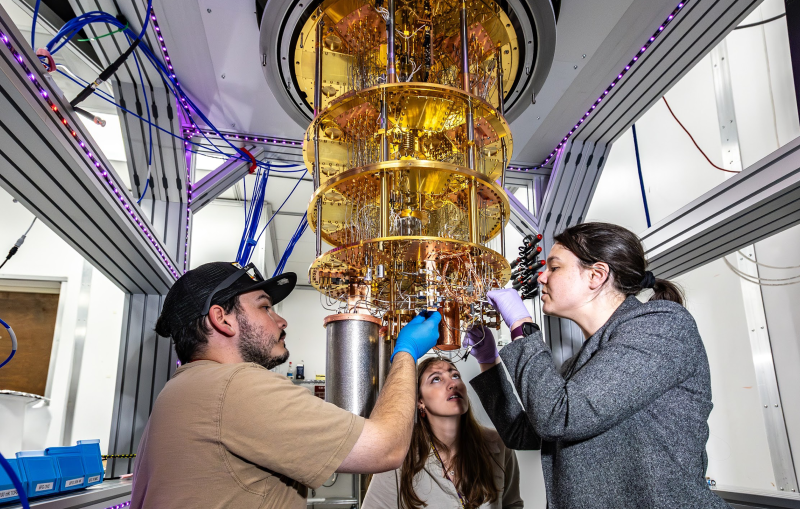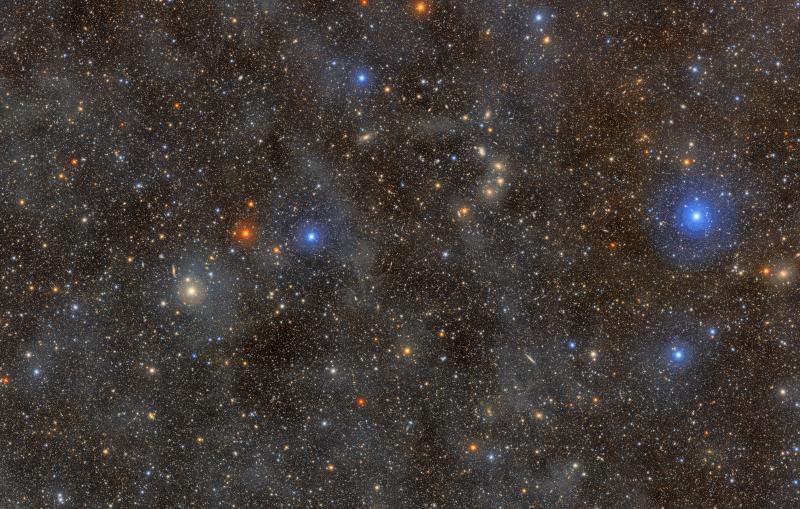
Quantum sensing uses quantum phenomena to detect extremely subtle signals or changes that are beyond the reach of many traditional sensors. At the Department of Energy's SLAC National Accelerator Laboratory, researchers use superconducting qubits and other quantum sensors to measure these signals with extraordinary sensitivity. These sensors can detect single particles or faint cosmic signals with extreme precision to advance particle physics and explore the universe’s mysteries.
Some existing dark matter experiments leverage quantum sensors to pick up extraordinarily small signals. For example, the Axion Dark Matter eXperiment (ADMX) uses a radio sensitive enough to pick up four bars of cell phone reception on Mars, all thanks to the use of quantum amplifiers. The amplifiers must be operated in an ultra-cold environment with shielding from magnetic fields to ensure robust performance and minimal added noise to the signal. A related effort, the Dark Matter Radio project led by SLAC and Stanford, looks for similar signals at lower frequencies, targeting lighter forms of dark matter. While ADMX focuses on one part of the spectrum, Dark Matter Radio explores another, covering a wider range of possibilities in the search for dark matter.
SLAC researchers build and use quantum sensors to search for dark matter particles and neutrino interactions, and to study the cosmic microwave background, the oldest light in the universe.
SLAC, in collaboration with Q-NEXT – a DOE National Quantum Information Science Research Center – and other partners, is advancing the SLAC Superconducting Quantum Foundry (SSQF), which includes facilities such as Nano-X – a cleanroom for nanoscale fabrication – and the Detector Microfabrication Facility (DMF). The DMF, specializing in high-precision fabrication of superconducting quantum devices, will play a crucial role in developing advanced quantum sensors.
Panofksy fellow at SLACWe develop state-of-the-art sensors that surpass traditional technologies, opening doors to significant discoveries, including those related to dark matter.

“SLAC is exceptionally well positioned for quantum sensing, bringing together unparalleled expertise and resources, including multiple dilution refrigerators that achieve the ultra-cold temperatures necessary for superconducting circuits,” says Chelsea Bartram, a Panofksy fellow at SLAC who is leveraging quantum sensors to hunt for dark matter. “We develop state-of-the-art sensors that surpass traditional technologies, opening doors to significant discoveries, including those related to dark matter.”
“Quantum sensing and particle physics naturally complement each other,” adds Kelly Stifter, a Panofsky fellow at SLAC specializing in dark matter detector development. “In high energy physics, we strive to detect incredibly small amounts of energy, which drives us to embrace innovative technologies like quantum sensors. Our collaboration with Stanford University, combined with our expertise in fabricating superconducting sensors, gives SLAC an edge in advancing this field.”
For questions or comments, contact the SLAC Office of Communications at communications@slac.stanford.edu.
Quantum explained

Related stories


Containing multitudes: SLAC scientist collaborates to create scalable qubits